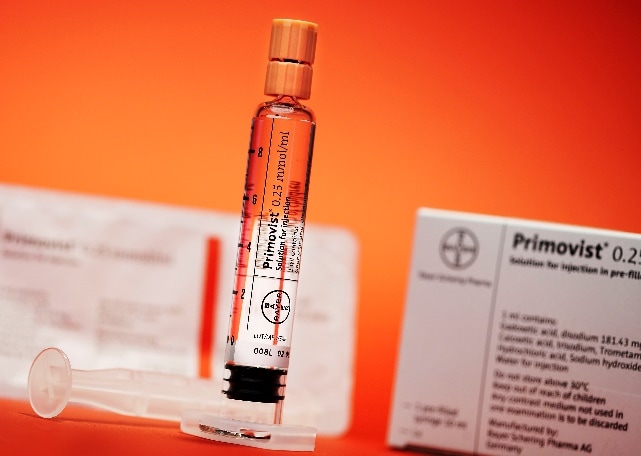
Primovist® 0.25 mmol / mL, solution for injection, prefilled syringe (gadoxetate disodium). Prescribing Information (Refer to Full Summary of Product Characteristics (SmPC) before prescribing).
Presentation: Each mL solution for injection contains 181.43 mg / mL gadoxetate disodium.
Indication: Detection of focal liver lesions and providing information on the character of lesions in T1-weighted magnetic resonance imaging (MRI).
Posology and method of administration: Primovist® should be used only when diagnostic information is essential and not available with unenhanced MRI and when delayed phase imaging is required. Observe usual safety precautions for MRI (e.g. exclude cardiac pacemakers and ferromagnetic implants). Use lowest dose that provides sufficient enhancement for diagnostic purposes calculated based on the patient’s body weight, and do not exceed the recommended dose. Administer dose undiluted as an intravenous bolus injection at a flow rate of about 2 mL / sec. After injection, flush cannula / line with 0.9 % saline. Observe patients for at least 30 minutes after the injection.
Recommended doses are:
Adults: 0.1 mL / kg body weight. Impaired renal function: Use of Primovist® should be avoided in patients with severe renal impairment (GFR < 30 mL / min / 1.73 m2) and in patients in the perioperative liver transplantation period unless the diagnostic information is essential and not available with non-contrast enhanced MRI. If use cannot be avoided, dose should not exceed 0.025 mmol / kg body weight. Do not use more than one dose per scan. Do not repeat the dose for at least 7 days.
Patients with hepatic impairment: No dose adjustment necessary.
Paediatric population: The safety and efficacy of Primovist® have not been established in patients under 18 years old. However, an observational study was performed in 52 paediatric patients (aged > 2 months and < 18 years). Patients were referred for Primovist® contrast-enhanced liver MRI to evaluate suspected or known focal liver lesions. Additional diagnostic information was obtained when combined unenhanced and enhanced liver MR images were compared with unenhanced MR images alone. Serious adverse events were reported, however none were assessed by the investigator to be related to Primovist®. Due to the retrospective nature and small sample size of this study, no definitive conclusion can be made regarding efficacy and safety in this population. No dose adjustment necessary. Elderly population (≥ 65 years): No dose adjustment necessary. Exercise caution.
Accumulation in the body: After administration of Primovist® gadolinium (Gd) can be retained in the brain and in other tissues of the body and can cause dose-dependent increases in T1w signal intensity in the brain, particularly in the dentate nucleus, globus pallidus, and thalamus. Signal intensity increases and non-clinical data show that Gd is released from linear GBCAs. Clinical consequences are unknown. The possible diagnostic advantages of using Primovist® in patients who will require repeated scans should be weighed against the potential for deposition of Gd in the brain and other tissues.
Contraindications: Hypersensitivity to active substance or to any excipients.
Warnings and precautions: It is recommended to screen all patients for renal dysfunction by obtaining laboratory tests, particularly patients over 65 years. Nephrogenic systemic fibrosis (NSF) has been reported with some gadolinium-containing contrast agents in patients with acute or chronic severe renal impairment (GFR < 30 mL / min / 1.73 m2); Patients undergoing liver transplantation are at particular risk since incidence of acute renal failure is high in this group. Use should be avoided in patients with severe renal impairment and in patients in perioperative liver transplantation period unless diagnostic information is essential and not available with non-contrast enhanced MRI. Haemodialysis shortly after Primovist® administration may be useful at removing Primovist® from the body. There is no evidence to support initiation of haemodialysis for prevention or treatment of NSF in patients not already undergoing haemodialysis.
Use with caution in patients: with severe cardiovascular problems; with, or with a family history of, congenital long QT syndrome; with drugs known to prolong cardiac repolarisation, particularly in patients with previous arrhythmias. Should not be used in patients with uncorrected hypokalaemia. Primovist® may cause transient QT prolongation. Allergy-like reactions, including shock, reported rarely. Patients with a history of allergic disorders or bronchial asthma or who have previously reacted to contrast media are at higher risk of hypersensitivity reactions. Most reactions occur within 30 minutes of administration but rarely delayed reactions may occur after hours to days. Appropriate drugs and instruments for treatment of hypersensitivity must be readily available. Hypersensitivity reactions can be more intense in patients on beta-blockers, particularly in patients with asthma. Patients taking beta-blockers who experience hypersensitivity may be resistant to treatment effects of beta-agonists. If hypersensitivity reactions occur, stop injection immediately. Do not administer intramuscularly due to risk of local intolerance reactions including focal necrosis. Consider the sodium content (11.7 mg / mL) for patients on controlled sodium diet.
Interactions: Potent OATP inhibitors could cause drug interactions reducing the hepatic contrast effect. No clinical data exists to support this theory. Elevated levels of bilirubin or ferritin can reduce the hepatic contrast effect of Primovist®. Primovist® may interfere with serum iron determinations for up to 24 hours after administration.
Pregnancy and lactation: There are no data from use in pregnant women. Animal studies have shown reproductive toxicity at repeated high doses. Should not be used in pregnancy unless clinical condition of the woman requires the use of Primovist®. Gd-containing contrast agents are excreted into breast milk in very small amounts. Continuing or discontinuing breast feeding for 24 hours after administration should be at discretion of the doctor and lactating mother.
Undesirable effects: (please refer to the Contraindications and the Warnings and Precautions sections). Usually mild to moderate and transient. The most serious adverse reaction is anaphylactoid shock. Delayed allergoid reactions (hours later up to several days) are rare. Common: Headache, nausea. Uncommon: Vertigo, dizziness, dysgeusia, paraesthesia, parosmia, increased blood pressure, flushing, dyspnoea, respiratory distress, vomiting, dry mouth, rash, pruritus, back pain, chest pain, injection site reactions, feeling hot, chills fatigue. Rare: Tremor, akathisia, bundle branch block, palpitation, maculopapular rash, hyperhidrosis, malaise. Additionally, altered laboratory tests and transient QT prolongation were reported. Frequency not known: Hypersensitivity/anaphylactoid reaction (including shock*, hypotension, pharyngolaryngeal oedema, urticaria, face edema, rhinitis, conjunctivitis, abdominal pain, hypoesthesia, sneezing, cough, pallor), tachycardia and restlessness.*Lifethreatening and / or fatal cases have been reported post marketing. Prescribers should consult the SmPC in relation to other side effects.
Overdose: In excessive inadvertent overdose, monitor patient including cardiac monitoring (for possible induction of QT prolongation); remove by haemodialysis. However there is no evidence that haemodialysis is suitable for prevention of nephrogenic systemic fibrosis (NSF).
Reporting of suspected adverse reactions: Adverse events can be reported to
DrugSafety. GPV.US@bayer.com.
Date of revision text: December 2017.
Please note: For current prescribing information refer to the package insert and / or contact your local Bayer AG.